

Recent Updates

We launched AI learning feature.

Hammer

Hammer

The Hammer is a single day pattern. This occurs when the price of the asset being traded  goes down significantly lower than the opening price and then bounces back on the same day to close near the opening price.

Hammer Candlestick has a small real body and long lower shadow. Usually Lower shadow is at least twice the size of the real body. 

Hammer candlestick is considered as a bullish reversal pattern.

Psychology of Hammer pattern is that market is in a downtrend and 

On the market day  open bears start selling resulting in price decline.During the day, bulls  take over control and push prices back towards the start of the day price. The closing price can be above or below the open, although the close should be near the open in order for the real body to remain small. After hammer, traders have to get confirmation of  asset price movement upwards. 

Where Doji indicates price reversal or trend continuation, hammer signals a potential upside reversal.


Practice Hammer – Beginner

Practice Hammer – Intermediate

Gravestone Doji

Gravestone Doji

The Gravestone Doji is a single day pattern. This occurs when the open and close are at the bottom. Candlestick has a long upper shadow and no lower shadow.. It is OK for Gravestone Doji  to have a very small lower shadow. 

Gravestone Doji is considered as a possible top reversal pattern i.e bearish.


Psychology of Gravestone Doji pattern is that the market is on an uptrend and on the day when Gravestone Doji appears bulls  are able to push prices upwards. During the day, bears take over control and push prices back to the start of the day price. It is very common for the upper  shadow of the Gravestone  Doji to act as an area of support for future prices. 

Gravestone Doji is the opposite of Dragonfly Doji.

The longer the upper shadow and higher the price level of the Gravestone doji indicates strong bearishness. Gravestone Doji Gravestone Doji-1 Gravestone Doji-2 Gravestone Doji-3


Practice Gravestone Doji – Beginner

Top 10 Free Apps for Daily Self-Learning

Top 10 Free Apps for Daily Self-Learning


It is what we know already that often prevents us from learning –  Claude Bernard


Here are Top 10 free apps and websites our team uses on daily basis to learn something new and improve everyday! 

Favourite Apps for Daily self-learning


1: Duolingo  App for daily free language learning education for free.

2: Youtube –App for video based learning from creators all around the world. 

3: Podcast App –  App to listen to audio content from creators all around the world. 

4: freeCodeCamp– App to help people learn to code for free. 

5: Edx – High quality education from top universities in the world. 

 6Coursera – High quality education from top universities in the world. 

7: Goodreads – An app to find your next favourite book.

8: Wikipedia – App which is a free online encyclopedia created and edited by volunteers around the world. 

9: Lumosity – App with games to improve memory, attention, flexibility, problem solving, and speed of processing. high resolution images and videos of artworks and cultural artefacts from organisations around the world. 

10:  Quora – App to ask questions to gain and share knowledge.

Lifelong Learning!

Lifelong Learning!


Lifelong Learning is a continuous pursuit for acquiring knowledge for either personal or professional reasons  –  Commission of the European Communities

The Delors Report stressed on the importance of learning  over the course of a lifetime and also highlighted four pillars of learning. 
1 Learning to know.
2 Learning to do.
3 Learning to be.
4 Learning to live together

So how to be a Lifelong learner? 

FalconFunda team have put together a step by step approach and important actions you can take today  to begin your journey as a lifelong learner.

Step 1 : Identify your interests & passions and make a list.
Action
:Use the
Princeton Review Career Quiz to identify your personal interests.

Step 2 : Identify your Learning goals for each of your interests / passions. Start with one interest /passion.
Action :  Use a SMART Objective framework to set yourself a learning goal. 

Step 3 : Find your learning style using VARK.
Action :Use Vark Questionnaire as a tool to discover your learning style.

Step 4 : Find online communities  to connect with people who have similar interest  / passion.
Action : Do Google search community + <name of your interest > keyword and look at the top 3 results. 

Step 5 : Find a website / app to Learn Fundamentals concepts of your interest / passion.
Action : Research and identify self-learning resources / tools. Choose one learning resource ( i.e Website or App ) and try to learn the fundamental / basic concepts of  your interest / passion.  

Step 6:  Develop Growth Mindset.
Action: Use the skills at every given opportunity, Be  Curious, Consume latest information in the area of interest on daily/ weekly basis through blogs, books / podcasts, news. Challenge your assumptions!

Step 7 : Maintain a Learning Logand keep updating on a regular basis – ideally daily / weekly basis.
Action :  Start capturing information into a document( Google Doc/ iPhone Notes/Microsoft Word ) on your phone or compute.

With FalconFunda.com you can  self-learn fundamental concepts of investing / trading in financial market(s).

Learn with FalconFunda.com


So many books, so little time – Frank Zappa

So many books, so little time – Frank Zappa


‘Employ your time in improving yourself by other mens writing so that you shall gain easily by what others have laboured hard for’ – Socrates.

One of the common themes  in the path from novice to master, amateur to professional, inexperienced to expert is learning.

Below are some of the favourite books of  FalconFunda team members. These books have helped us to get inspired, learn more effectively and make learning a fundamental part of our nature!


1 Make It Stick: The Science of Successful Learning   – Peter C. Brown Henry L. Roediger III Mark A. McDaniel 


 2 The 5 Elements of Effective Thinking  –  by Edward B. Burger , Michael Starbird


3 Think Again: The Power of Knowing What You Don’t Know by Adam Grant


4 The 80/20 Principle: The Secret to Achieving More with Less   by  Richard Koch 


5 Grit : The Power of Passion and Perseverance by  Duckworth, Angela 


 6 The Tipping Point: How Little Things Can Make a Big Difference  by Malcolm Gladwell 


7 Tiny Habits: The Small Changes That Change Everything by    B.J. Fogg 


8 Smarter Faster Better: The Secrets of Being Productive in Life and Business by Charles Duhigg 


9 Black Box Thinking: Why Some People Never Learn from Their Mistakes – But Some Do   by Syed, Matthew


10 Start with Why: How Great Leaders Inspire Everyone to Take Action  – Simon Sinek 


FalconFunda – Starting with Why!

FalconFunda – Starting with Why!

We are on a mission to identify and organise fundamental concepts of modern finance to help traders and investors easily learn, remember & discover market opportunities in a fastest way possible.

FalconFunda Brand Story


Behind the brand!

‘There is no end to education. It is not that you read a book, pass an examination, and finish with education. The whole of life, from the moment you are born to the moment you die, is a process of learning’ – Jiddu Krishnamurti 

Ultimately, education in its real sense is the pursuit of truth. It is an endless journey through knowledge and enlightenment. A. P. J. Abdul Kalam

Live as if you were to die tomorrow. Learn as if you were to live forever –  Mahatma Gandhi

You can practice shooting eight hours a day, but if your technique is wrong, then all you become is very good at shooting the wrong way. Get the fundamentals down and the level of everything you do will rise  – Michael Jordan

Success is all about consistency around the fundamentals  –  Robin Sharma

All compromise is based on give and take, but there can be no give and take on fundamentals. Any compromise on mere fundamentals is a surrender. For it is all give and no take  – Mahatma Gandhi

Fundamental preparation is always effective. Work on those parts of your game that are fundamentally weak  –  Kareem Abdul-Jabbar

Success is neither magical nor mysterious. Success is the natural consequence of consistently applying the basic fundamentals – Jim Rohn

First master the fundamentals  – Larry Bird

“The best thing about the future is that it comes one day at a time.”  ― Abraham Lincoln

In a world of constant change, the fundamentals are more important than ever – James C. Collins

Learning never exhausts the mind – Leonardo da Vinci

We believe in intentional  bitesize everyday skill learning –  We are Falcons!

Charts

Charts

In order to study how the price of a traded security moves, a trader needs some sort of way to look at its historical and current price behavior.A  price chart is usually a preferred first tool that most of the traders use for technical analysis 
A chart is simply a visual representation of a traded security’s price over a set period of time.

On the chart, the y-axis (vertical axis) represents the price scale and the x-axis(horizontal axis) represents the time scale. Prices are plotted from left to right across the x-axis.


A chart aggregates every buy and sell transaction of that financial instrument (in our case, currency pairs) at any given moment. A price chart depicts changes in supply and demand.

Below are the some of the most popular types of Price Charts

  1. Line chart 
  2. Bar chart
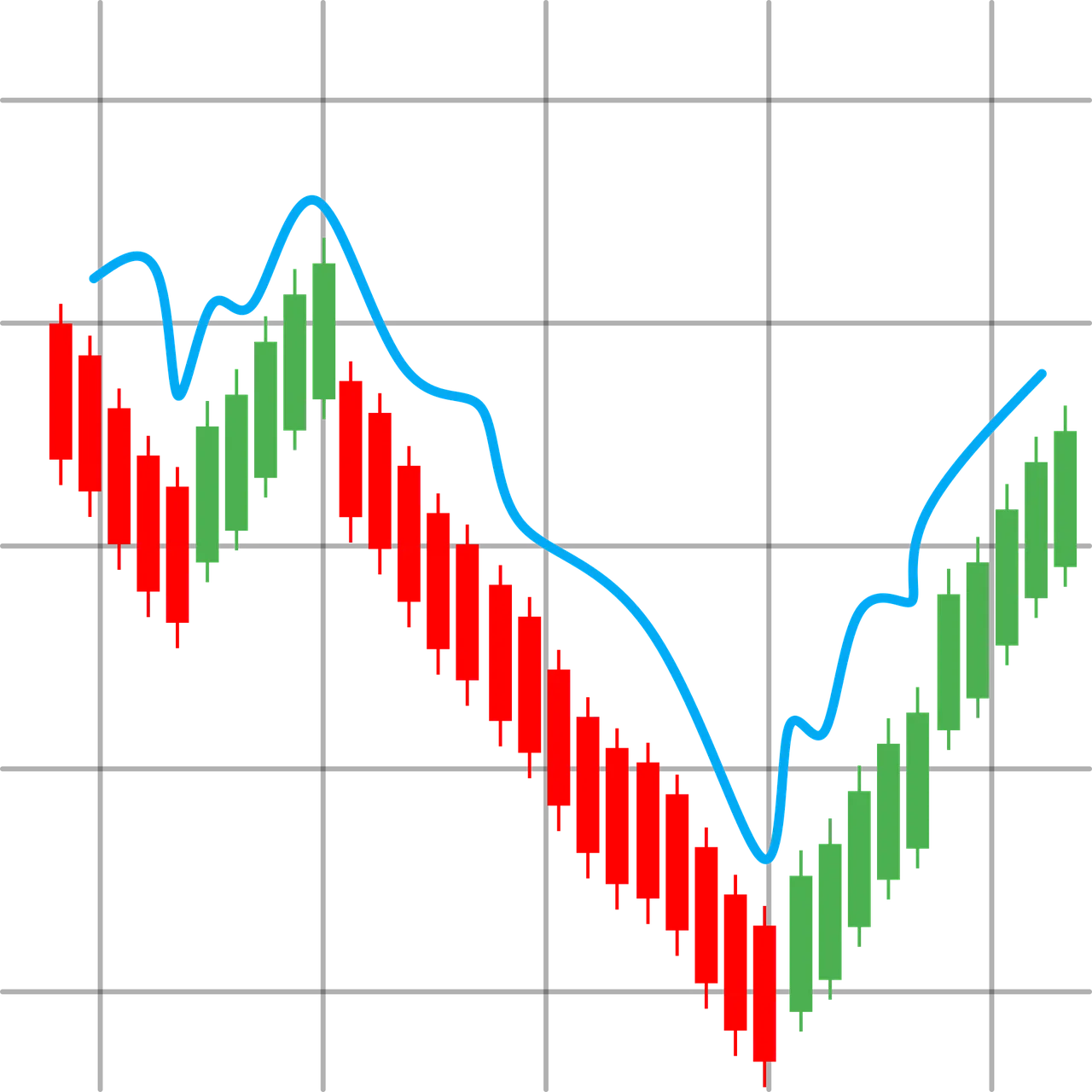
  3. Candlestick chartCharts&Type -Content Image

Charts are useful  because they make it easier for us to present securities being traded in a visual and organized manner.
Charts blend all activity from the millions of market participants of all types and it doesn’t matter  whether they’re humans or machines!

Practice Charts & Types – Beginner

Practice Charts & Types – Intermediate


Financial Markets

Financial Markets

A market is a place where two parties can gather to facilitate the exchange of goods and services. 
Financial market refers to any place where securities , derivatives , commodities, currencies are traded between two parties.
Examples of securities are shares, bonds, options, mutual  funds, ETF’s, Debt.
There are primarily two types of markets. Capital Markets and Money Markets. These markets act as a source of raising finance for businesses.Capital markets are used for long term financing and Money markets for short term financing. 
Stocks, Bonds, Derivatives, commodities are examples of capital markets. Assets like Treasury Bills, Certificates of deposits from banks, Commercial papers from corporations fall under money markets. 

Some of the most popular types of financial markets  are :
Stock Market 
Over-the-Counter Market
Bond Market
Money Market
Derivatives Market
Forex Market
Commodities Market
Cryptocurrency Market
Futures Market

All of these markets can be either physical or virtual.

Practice Financial Markets – Beginner


Bearish Engulfing

Bearish Engulfing

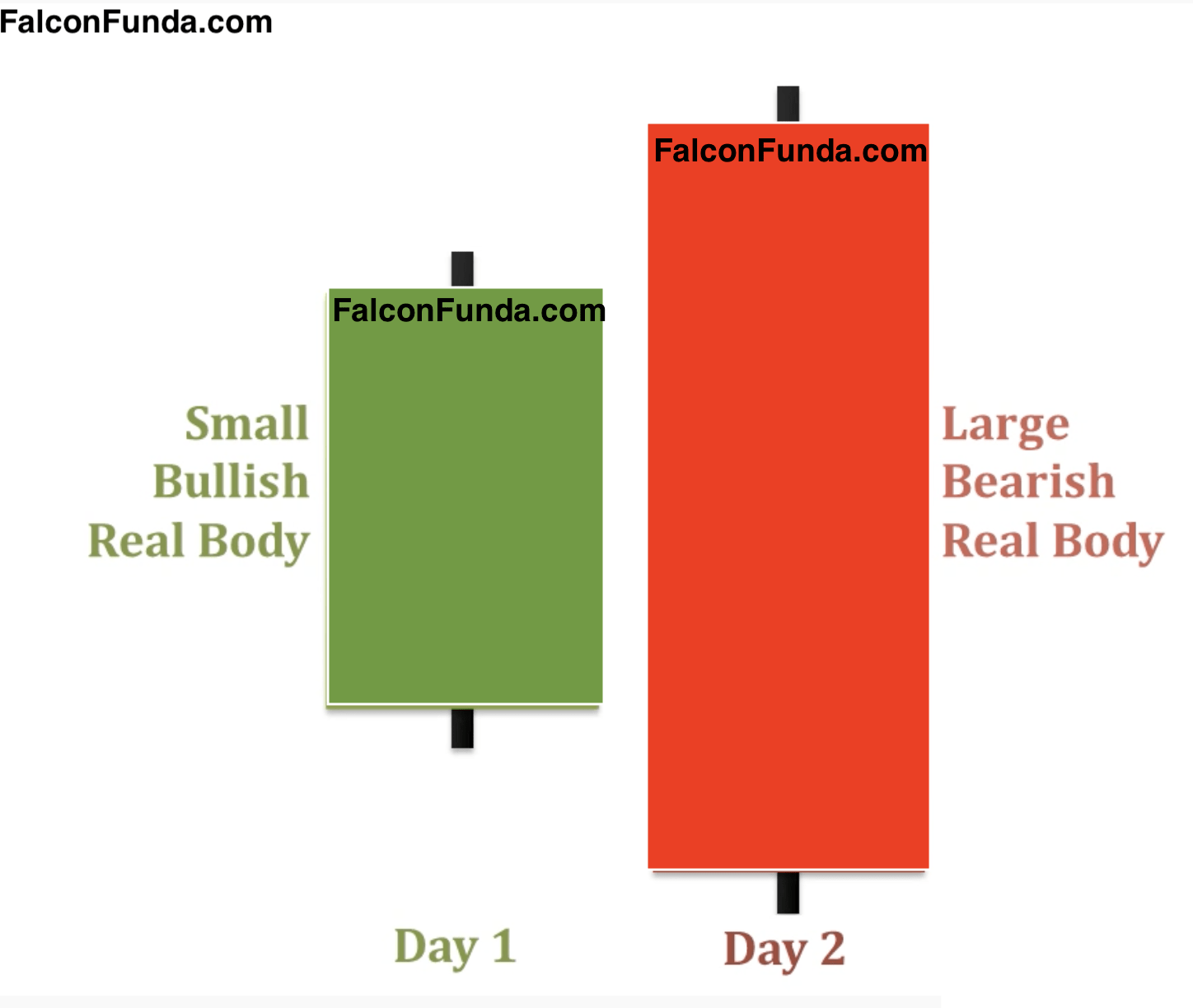
The Bearish Engulfing  pattern is a two day trend reversal pattern.It  has one bullish candlestick and a bearish candlestick.
First day is a bullish candlestick and it can be a doji. It basically has a small real body.
Second day is a bearish candlestick with a large real body and is taller than the first day’s candle.
The open and high of the second day should be greater in price than the first day’s close and the second day’s close and low should be less than the first day’s opening price.

After an uptrend, a small bullish candle appears showing that bulls are unable to push prices much higher as they have been able to do previously. As a reminder, a small bullish candlestick shows bulls having less power compared to large bullish candlestick which shows bears having more power. Similarly, a large bearish candlestick that appears after an uptrend shows that bears are able to come back into the market and the bulls were unable or unwilling to stop this bearish assault. The longer the bearish candlestick is, the more powerful the bears were.

Psychology of this pattern is that the market  is in uptrend and bulls are in control until the first day. On the second day bears completely rejected bulls and pulled the price down which resulted in the change of trend from bullish to bearish i.e trend reversal. 

Practice Bearish Engulfing – Beginner